
A Comparative Study of Cast Iron vs. Copper Propellers

Cast iron propellers and copper propellers each exhibit distinct characteristics in marine propulsion; however, from a comprehensive performance perspective, copper propellers hold significant advantages.
The primary advantage of cast iron propellers lies in their low material cost—typically 30-40% lower than that of copper propellers. Nevertheless, they exhibit high density, low strength, and poor corrosion resistance, and are particularly susceptible to electrochemical corrosion in seawater—resulting in a relatively short service life. Although cast iron demonstrates excellent castability, it is difficult to machine, highly brittle, and lacks impact resistance, rendering it prone to fracture when struck by floating objects. In contrast, while copper propellers entail a higher initial cost, their superior seawater corrosion resistance, favorable mechanical strength, and good toughness enable them to achieve a longer service life. Additionally, copper alloys have a relatively low density, which can reduce the propeller’s weight and thereby improve the ship’s loading capacity. More importantly, copper alloys possess better casting and machining properties, allowing for the fabrication of more precise blade profiles and, in turn, enhancing propulsion efficiency. From a long-term economic perspective, the total cost of ownership of copper propellers is often lower than that of cast iron propellers. This is mainly reflected in their longer replacement cycle (usually 2-3 times that of cast iron propellers), higher propulsion efficiency (with an improvement of 5-8%), and lower maintenance costs.
Therefore, except for some small inland vessels that are extremely cost-sensitive, modern ships generally adopt copper propellers.
A Detailed Characteristic Analysis of Mainstream Copper Alloy Propellers
Among copper alloy propellers, CU1, CU3, and CU4 are the three most widely used materials, each with unique characteristics.CU1 (manganese bronze) contains approximately 55-60% copper, alloyed with manganese, iron, aluminum, and other elements. It boasts moderate strength, good corrosion resistance, relatively low material cost, and excellent processability, making it suitable for manufacturing propellers of small and medium-sized ships. However, its cavitation erosion resistance is average, so it is not suitable for high-speed ships.CU3 (nickel-aluminum bronze) contains approximately 78-82% copper, alloyed with nickel, aluminum, iron, and other elements. It boasts excellent comprehensive properties: its strength is 30-40% higher than CU1, its corrosion resistance—especially cavitation erosion resistance—is significantly enhanced, and it maintains good castability and processability. Though its material cost is 20-25% higher than CU1, its longer service life and superior performance make it the preferred choice for medium and large commercial ships.CU4 (high-strength nickel-aluminum bronze) is an upgraded version of CU3 with optimized composition, containing approximately 75-78% copper. By adjusting the proportions of nickel, aluminum, and other elements, it achieves 15-20% higher mechanical strength than CU3 and superior cavitation erosion resistance, making it particularly suitable for ships with high strength requirements such as large container ships and oil tankers. However, its material cost is an additional 15-20% higher than CU3, and it also poses greater processing challenges.
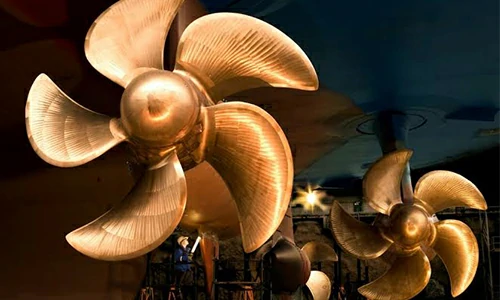
In terms of quality stability: CU3 delivers the most balanced performance, with mature production processes and minimal performance fluctuations; while CU4 offers the best performance, it demands extremely strict control over production processes—casting defects are likely to occur if there is any slight oversight; CU1, due to its relatively simple composition, maintains good quality stability but has a lower performance ceiling.
Regarding applicable navigation areas: CU1 is suitable for inland river and coastal ships; CU3 is applicable to ocean-going merchant ships, including those operating in ice zones; CU4 is specifically designed for large high-speed ships and special working conditions.
The Importance of Material Compliance and the Value of Certified Propellers
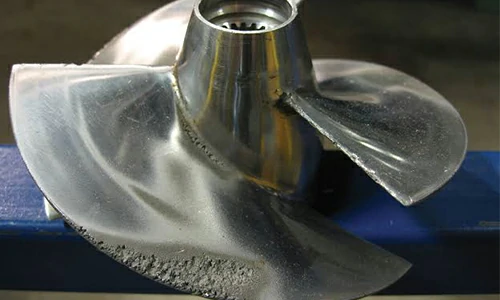
The propeller labeled as CU3 may have vastly different actual performance due to the differences in its material composition.A standard CU3 alloy contains 78-82% copper, 4.5-6.5% aluminum, 4-5% nickel, 3-5% iron, and small amounts of manganese and other elements.However, there are a large number of non-compliant “CU3” propellers on the market, with common issues including insufficient copper content (which may be as low as 75%) and substitution of valuable elements such as nickel and aluminum with cheaper alternatives.While such propellers may cost 20-30% less than qualified products initially, their performance and service life drop drastically: tensile strength can decrease by 30-40%, corrosion resistance by over 50%, and they may need replacement after only 1-2 years of service in marine environments—whereas qualified CU3 propellers typically last 5-7 years.
From the perspective of processing costs, compliant materials feature precise composition, stable castability and processability, and low scrap rates. In contrast, non-compliant materials suffer from significant compositional fluctuations, pose greater processing challenges, and have high scrap rates—resulting in actual production costs that may rise rather than fall.
Certified propellers (accompanied by material certificates, mechanical property test reports, etc.), though higher in price, offer guaranteed quality and ultimately lower overall operating costs.
Taking a 5,000-ton cargo ship as an example, using uncertified “CU3” propellers may save around 50,000 yuan initially. However, due to premature replacement and efficiency losses, the total cost over five years is likely to be 150,000 to 200,000 yuan higher than that of using certified products. In addition, certified propellers offer distinct advantages in insurance claims, ship inspections, and other related matters. Therefore, from the perspectives of total lifecycle cost and quality assurance, choosing qualified copper alloy propellers with complete certification is a far wiser decision.


